During the Yuan dynasty (established by the Mongols), since the Mongolian and other northern minorities did not attach importance to light, soft, thin, and transparent fabrics, women’s clothing gradually developed into a jacket with a lining. Thick fabrics such as brocade and velvet were widely used, which stayed prevalent until the Ming and Qing dynasties.
Meanwhile, the fashion of wearing strapless upper garments and clothes bearing the chest and neck in the Song culture disappeared from the north to the south. Finally, the casual look of women’s clothing in the Central Plains declined.
The Hu culture introduced buttons into the Central Plains during the previous dynasty. However, before the Ming dynasty, buttons were mostly used for men’s round-neck gowns.As late as the Jin-Yuan period, because of the influence of Mongolian women, buttons were used for the undergarments of Han women and finally began to be used for the outer garments in the middle and late Ming dynasties.
Thanks to buttons, the stand-up collar, which could fit the curve of the neck better, appeared. Compared with the open lapel, the stand-up collar could reduce the nakedness of the neck conveniently and effectively without hurting the aesthetics.
The use of buttons and stand-up collars revolutionized the style of women’s jackets and became the main feature of women’s wear in the Qing dynasty. The Chinese coat, which is still regarded as part of the national dress today, was formed in this period.
Chinese traditionalembroidery techniques and various thematic auspicious motifs were also developed further.
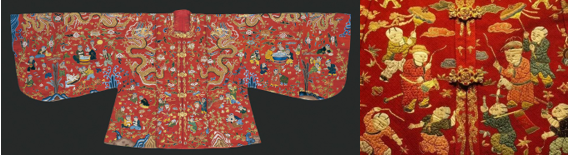
The Ming Empress Xiaojing’s jacket with a hundred children embroidered with sprinkled thread
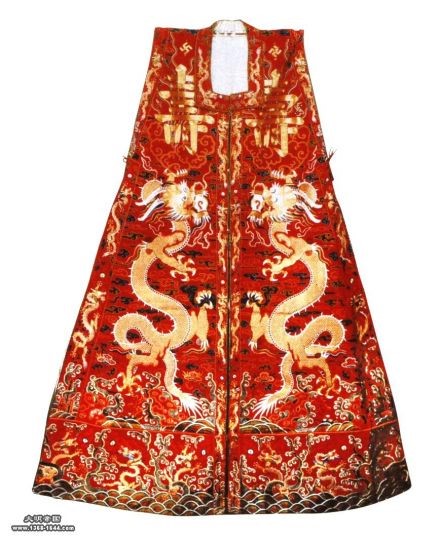
The embroidered Bijia of the Ming Empress Xiaojing with the ascending dragon and longevity motifs
The Bijia is a collarless vest with slits on both sides and is longer than normal vests later that usually reached the hip or knee. The Bijia was popular in the Yuan and Ming dynasties. Although the Bijia was originally especially worn for empresses, it gradually spread and prevailed among ordinary people in the middle of the Ming dynasty.
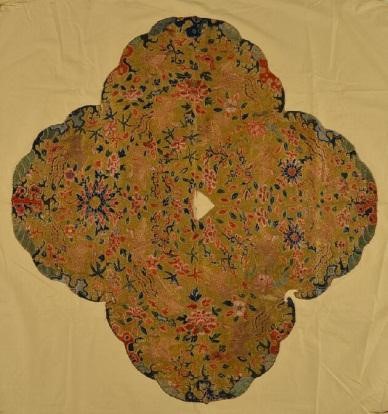
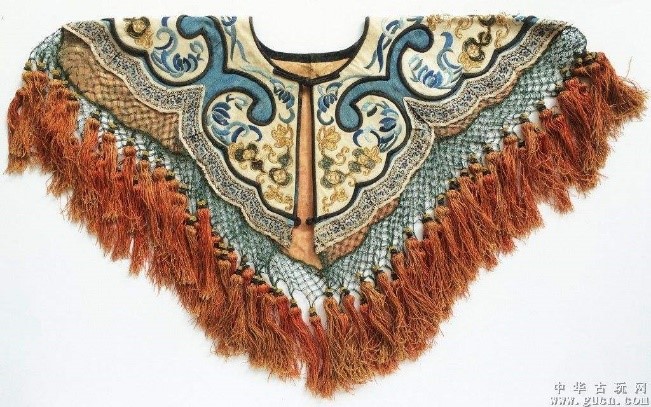
The Yujian (a kind of wrap) was first seen in the murals of the Sui dynasty at Dunhuang. During the Ming and Qing dynasties, it spread across all social classes, and became an indispensable piece of clothing decoration for Han women, especially at weddings.
The original function of the Yunjian was to keep stains away from the collar and shoulders of garments, but it gradually evolved into an ornament made of colored brocade embroidery.
The Big Yunjian with an embroidered phoenix and peony pattern of the Ming dynasty
Yunjian, embroidered with Golden Gourd Patterns, the Qing dynasty