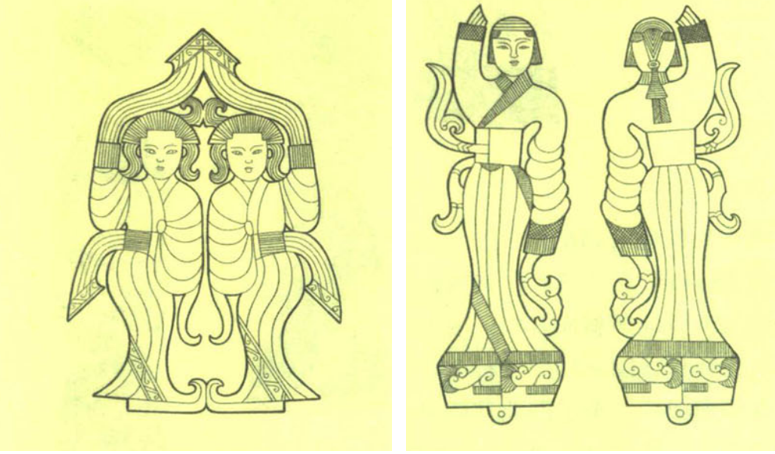
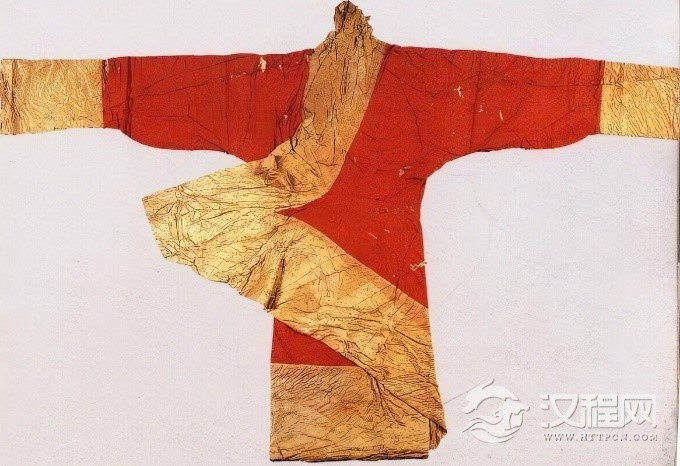
From the Qin to the early Han dynasty, the clothing form was a long full-body garment belonging to something known as the “Sewn-Up System”, called Shenyi (深衣). Shenyi was not only the casual clothing of the literati and officials but also the formal attire of ordinary people. At that time, it is not shameful for women to expose their necks while wearing Shenyi. Rich, aristocratic women liked to wear Diagonal Body Wrapping Robes (曲裾), which were also a kind of Shenyi. The extended lapel of the Diagonal Body Wrapping Robe was a triangular cloth, which wraps around the female body from the waist to the knees, and then extends out. The overall shape was similar to the modern fishtail skirt showing the female body at its most beautiful.
Jade carving of Dancing Girl wearing Diagonal Body Wrapping Robe with long sleeve, the Warring States Period
Diagonal Body Wrapping Robe unearthed from the No. 1 Han tomb in Mawangdui, Changsha, Hunan, 1972
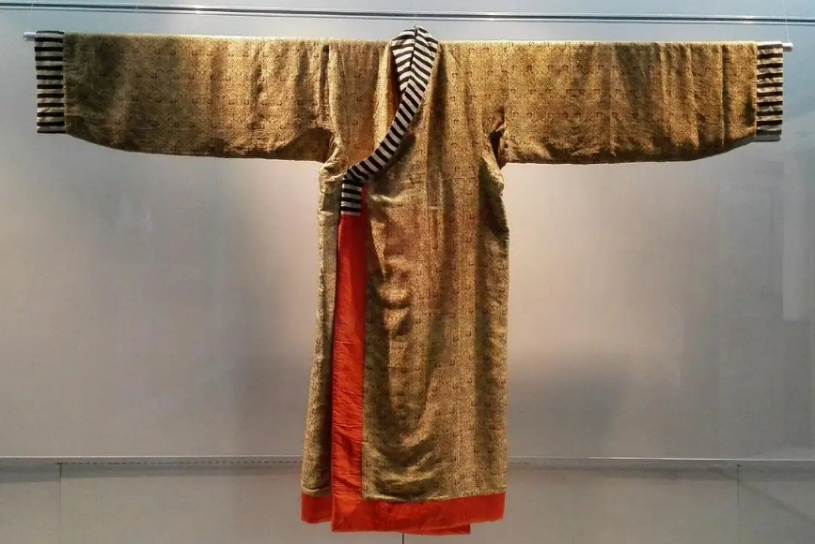
Straight lapel
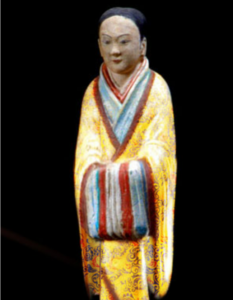
Triple Clothes Sculpture from Western Han Dynasty
During the Western Han dynasty, wearing multiple middle garments inside Shenyi gradually became popular. This style became known as the triple garment (the underwear, middle clothing, and outer clothing lapels could all be seen). The collar of the outer garment can be opened without sewing. Then multiple layers of middle garments are worn inside, so the colored edges of the multiple layers of collars are revealed layer by layer.
Since the wrap-around feature of Shenyi hindered people’s movements, it was gradually abandoned during the Eastern Han dynasty. Another form of cloth worn that separates upper garments and skirts became popular.