
618 to 1127 A.D.
Tang and Song
During the Tang dynasty, diplomatic dealings became frequent, and Confucianism, Taoism, and Buddhism prospered simultaneously. Consequently, the entire society moved towards openness, inclusiveness, and pluralism. Second, based on the progress made in silk reeling and dyeing techniques, the inconsistent quality and quantity of textile materials reached unprecedented heights.
The diversity of women’s clothes increased. Aside from developing the form of clothes worn during the Wei and Jin dynasties, women’s clothes during the Tang dynasty were more bright-colored——red and green were particularly preferred. Some new forms also rose. High-class Women were fascinated with low-necked garments. Skirts with plenty of pleats in the shape of sheep’s intestines and skirts made of feathers were also common in the everyday lives of these women. Furthermore, wearing men’s clothes became a fashion since there were more flexible and convenient for everyday activities. Meanwhile, the Hu military uniforms and clothing, which could be worn by both females and males, grew popular because of their practicality.
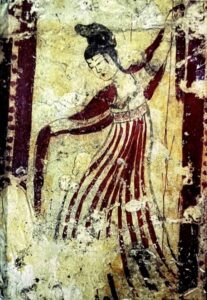
Murals of the red-dressed dancer in the Tomb of Zhishou Fengjie in Guodu Town, Chang’an District, Xi’an, Shaanxi
Skirts with different colors alternating with each other first appeared during the Wei and Jin dynasties and were also prevalent in the Tang dynasty. However, due to technical limitations, an alternate-color skirt was usually stitched together using only two different colored fabrics. Therefore, the joint between the two pieces of different cloth is also called a “split(破)”. The number of splits on a skirt also represented its owner’s social status. For example, a normal skirt of alternate colors often had five or six splits restricted by the Tang law, while extravagant people could sometimes have skirts that had as many as twelve splits.
A type of collarless, lapel opposite short jacket with sleeves up to the elbow was developed during Wei and Jin dynasties. By the early Tang dynasty, this kind of half-sleeved jacket had a formal name——Half-arm (半臂).
“Ru” is mostly tight, so wearing half-arms not only protected people from the wind and cold but also served as a decoration. Therefore, half-arms were widely worn in Tang dynasty. Moreover, the Emperor not only accepted this form but also adopted it as the form of “business” dress for the ladies at court. Gradually, half-arms soon became popular among the noblewomen as well.
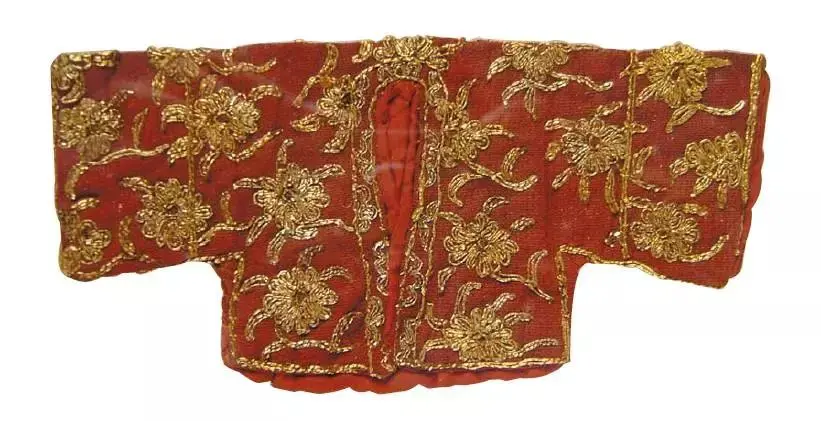
A half-arm with gold embroidery from the Tang dynasty was excavated in an underground palace at Famen Temple
By the Song dynasty, with the development of textile technology, there were more than 100 kinds of silk fabrics and brocades, and gold printing, embroidery, color painting, and other craft techniques also developed.The women’s clothing during the Song dynasty was developed based on clothing from the Tang era.Emerging late in the Tang dynasty, the outfit of wearing a strapless upper garment with a Beizi and a skirt became the basic form of women’s clothing in the Song dynasty (a Beizi is a kind of coat with a straight body, opposite lapel and long slits on both sides).
Song dynasty women wore Beizis without any ties, so the hem fluttered while they walked. Light-colored yarn and other types of translucent and flimsy fabrics were popular. For example, the tomb of Huang Sheng in Fuzhou unearthed many high-class silk fabrics that were light in texture, including a peony flower vest weighing only 16.7 grams.
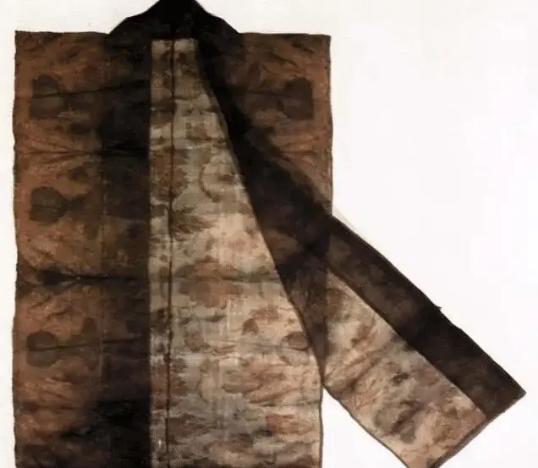
Peony vest unearthed from Song dynasty Huang Sheng’s tomb
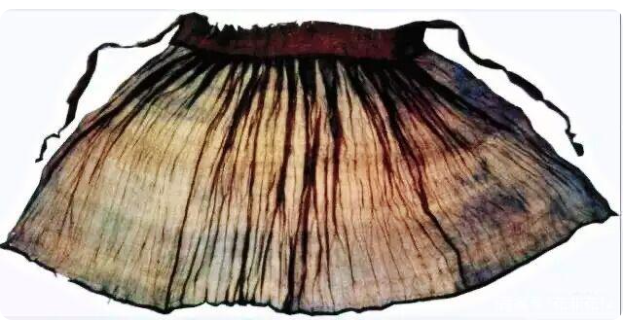
The pleated skirt of brown Luo unearthed from Song dynasty Huang Sheng’s tomb
Wearing trousers was another typical feature of the Song dynasty. Before it, short tops with trousers were the dress for poor women and were despised by society. Even during the Tang dynasty, when women wore men’s clothes and those from the Hu minority, trousers were only considered “ borrowed”. However, in the Song dynasty, women’s pants were no longer merely worn as underwear, but as fashionable outerwear. The double-layered, wide-legged pants with side slits flowed while walking. Most women also wore a short skirt or apron on the outside like modern culottes.
The popularity of trousers across all classes was attributed to the rapid development of the Song commercial economy as more and more women began to engage in commercial activities, and trousers that were easy to work in became widely popular and were favored by all classes. According to the following paintings of the Song dynasty, the unique attire of strapless upper garments, Beizi, and trousers is widely accepted by people from both noble and ordinary families.
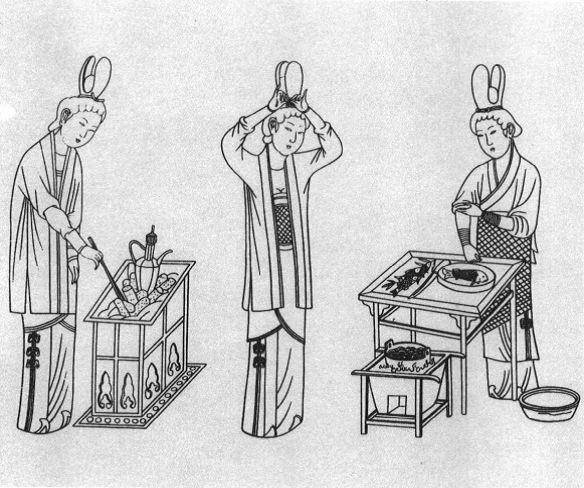
Kitchen maid carved on brick from a Song tomb in Yanshi, Henan
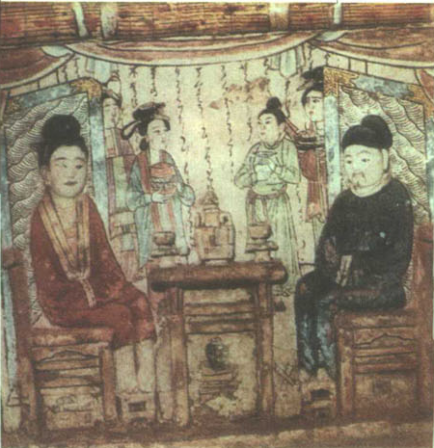
Landlord couple with round and cross-necked clothes, and tall coiffure
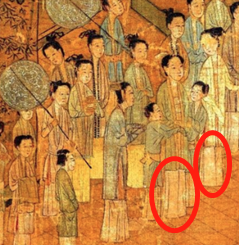
Auspiciousness Sign of the Revitalization in the middle(Part)